

How AI is changing e-commerce and how to gain control over it.
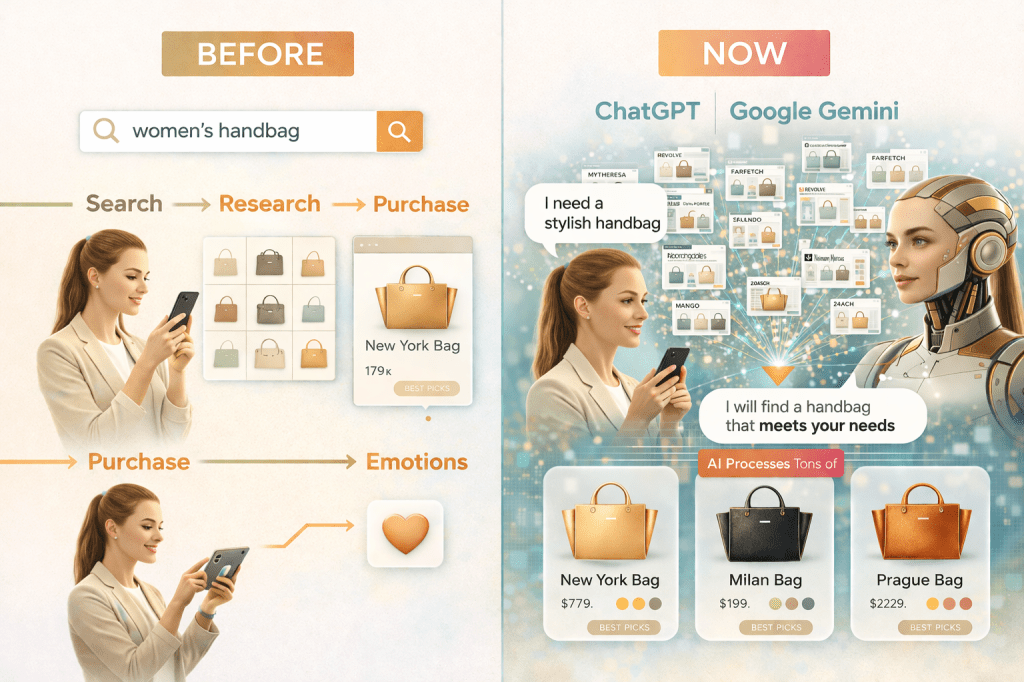
The way people shop online is starting to change subtly, yet fundamentally. Instead of browsing categories and filtering products, it is increasingly enough to simply ask a question. The customer types in what they are looking for, and AI tools like ChatGPT or Google Gemini offer them specific products they deem the best choice right away.
This shift moves control over product selection out of the hands of the customer and the e-shop itself into an environment that brands do not directly manage. For e-shop owners, this does not just mean another channel, but a new way for their products to reach customers. What gets displayed is no longer decided solely by marketing or search rankings, but primarily by how well the AI can understand the product.
Why data, not just marketing, is the deciding factor today?
While visibility used to be the main goal—getting the customer to the website and then convincing them to buy—today the focus is shifting to the data itself. AI does not work with visual impressions or the e-shop design, but with the information it has available about the product. If that information is incomplete, inaccurate, or inconsistent, the product simply will not make it into the selection.
This is precisely why product data quality is starting to play a key role. Having attractive descriptions or well-written SEO texts is no longer enough. Information must be structured in a way that allows it to be clearly interpreted. This applies not only to the descriptions themselves but also to parameters, variants, or the relationships between individual products. AI needs to understand exactly what you are selling, who the product is intended for, and in what situation it makes sense.
Context is equally important. A customer is not looking for a "product," but a solution to a specific need. AI, therefore, selects products based on how well they match a given situation. An e-shop that can clearly describe a product's use, its benefits, and its target audience has a significant advantage in this environment.
What does this mean for your e-shop in practice?
The brand itself also enters the game. If it is not clearly defined how the brand communicates, what its values are, or how it answers typical customer questions, the AI will fill in those gaps based on available sources. This can lead to a final communication that does not align with how the brand wants to be presented.
For most e-shops, the first step does not involve complex technological implementation. It is much more important to go back to basics and look at your own data through the lens of how AI works with it. Does your catalog structure make sense? Is the product information consistent? Is it clear in what context the customer should use the product?
Agentic commerce does not just bring new tools, but primarily a shift in thinking. Success is no longer based solely on how many people you bring to your e-shop, but on whether your product makes it into the selection before the customer even opens your website.
Brands that adapt their data and their way of thinking about products to this will gain an edge in an environment where visibility is determined not just by marketing, but by the ability to be understood correctly.


